 Distance or face-to-face education? Perception
in two groups of veterinary students after the pandemic
Distance or face-to-face education? Perception
in two groups of veterinary students after the pandemic
¿Educación a distancia o presencial? Percepción de dos grupos de estudiantes de veterinaria tras la pandemia
Distance or face-to-face education? Perception
in two groups of veterinary students after the pandemic
¿Educación a distancia o presencial? Percepción de dos grupos de estudiantes de veterinaria tras la pandemia
Juan Francisco Romero-López, jarl@unam.mx
Universidad Nacional Autónoma de México, México
 https://orcid.org/0000-0002-2997-8489
Melisa Chavarría Bielma, mel.chav.bielm@hotmail.com
Universidad Nacional Autónoma de México, México
https://orcid.org/0009-0006-1480-700X
José Juan Martínez-Maya, jjmm@unam.mx
Universidad Nacional Autónoma de México, México
https://orcid.org/0000-0002-9078-8297
DOI: 10.5281/zenodo.20613760
Palabras clave
Distance
education
Virtual environment
COVID 19
Techno-pedagogical design
Abstract: COVID-19 forced us to enable distance learning in order not to stop education altogether. This study aimed to develop a virtual learning environment (VLE) and compare academic performance in face-to-face and distance modalities, as well as students’ perceptions in both types of learning. A virtual learning environment (VLE) was developed in the Moodle platform on a subject of the Veterinary Medicine program. The course was taught both face-to-face and at a distance under the same conditions. The students were evaluated with the same criteria and their perception of the course was assessed with a questionnaire. A total of 11 students enrolled in the distance course and 8 in the face-to-face course. The mean grades were 9 and 10, respectively (p > 0.05). Perception of the course was better in the face-to-face modality in all but one question (p < 0.05). While performance and learning were similar, students preferred the face-to-face environment to the virtual one, as students seemed to value more social interaction. The usefulness of VLEs as a learning strategy has been demonstrated, but they cannot replace social contact.
Keywords
Educación a distancia
Entorno virtual
COVID-19
Diseño tecnopedagógico
Resumen: El COVID-19 nos obligó a implantar la enseñanza a distancia para no interrumpir por completo la actividad educativa. El objetivo de este estudio fue desarrollar un entorno de aprendizaje virtual (EAV) y comparar el rendimiento académico en las modalidades presencial y a distancia, así como las percepciones de los estudiantes respecto a ambos tipos de aprendizaje. Se desarrolló un entorno de aprendizaje virtual (EAV) en la plataforma Moodle sobre una asignatura del programa de Medicina Veterinaria. El curso se impartió tanto de forma presencial como a distancia en las mismas condiciones. Se evaluó a los estudiantes con los mismos criterios y se valoró su percepción del curso mediante un cuestionario. Se matricularon un total de 11 estudiantes en el curso a distancia y 8 en el curso presencial. Las calificaciones medias fueron de 9 y 10, respectivamente (p > 0,05). La percepción del curso fue mejor en la modalidad presencial en todas las preguntas excepto una (p < 0,05). Aunque el rendimiento y el aprendizaje fueron similares, los estudiantes prefirieron el entorno presencial al virtual, ya que parecían valorar más la interacción social. Se ha demostrado la utilidad de los entornos de aprendizaje virtual (EAV) como estrategia de aprendizaje, pero estos no pueden sustituir al contacto social.
Cómo citar:
Romero, J., Chavarría, M. y Martínez, J. (2026). Distance or face-to-face education? Perception in two groups of veterinary students after the pandemic. Revista Varela, 26(74):e2026267402.
Recibido: febrero
de 2026,
Aceptado: marzo de 2026, Publicado: 13 de junio de 2026
Education, undoubtedly one of the pillars of society, has undergone modifications depending on history and geography, always in a pursuit to improve learning. UNESCO (2019), defines education as a fundamental human right. It is a means by which socially and economically marginalized individuals can lift themselves out of poverty and participate fully in the life of their community. In this context, education consists in forming individuals who are capable of intellectual and moral autonomy and who, precisely by virtue of the rule of reciprocity, represent the autonomy of others; education is thus understood as the perfecting of the person, as growth in personal development (Ortiz, 2017).
Therefore, education is a strategic asset. Higher education in particular should be a space for analyzing the problems that affect a country; it should participate in their solutions by training professionals who combine theoretical knowledge with practical skills. Universities should be spaces for the formation of human capital capable of generating intelligent regions for the solution of the various problems that afflict their citizens, through useful and critical knowledge (Ortiz, 2017).
Higher education is faced with the additional challenge to innovate, to participate in scenarios characterized by the irruption of Information and Communication Technologies (ICTs). Applied in a didactic process, ICTs can acquire great value and become Learning and Knowledge Technologies (LKTs). Among other advantages, the use of ICT makes it possible not to be limited to a physical space; moreover, they make it possible to place the student at the center of the learning process, immersed in collaborative and cooperative digital environments based on constructivist pedagogical models. These tools enable education to adapt to an environment of constant change and uncertainty (Gargallo, 2018; Valarezo y Santos, 2019).
In these learning environments, students need to demonstrate an autonomous, self-motivated attitude and develop study skills. They must learn to make decisions and solve problems. Similarly, teachers will need not only to master these skills, but also to expand their knowledge to include new trends and theories that incorporate the management and optimization of ICT, as well as to change their beliefs and pedagogical practices. They will also need to join communities that provide the support and guidance they need in this area (Castel, 2018; Cueva, 2025).
ICT can be defined as any physical or virtual support medium that stores data and code in a portable form to enable communication between people (Calandra, Araya, & Mocelli, 2009).
In the short term, we can foresee a greater growth of ICT-based models in education, covering multiple contexts, both in-class and remote, at all levels of education. In this way, ICTs will make it possible to increase the coverage of education (Cueva, 2025).
The integration of ICT in the classroom should be a resource for learning and an agent of educational innovation, so that they can be implemented as Learning and Knowledge Technologies (LKT). ICT is used as a didactic tool for learning and knowledge acquisition, with the aim that students learn effectively through dynamics and practices supported by digital technology. LKTs provide teachers and students with an attractive learning scenario, capable of stimulating and promoting the ability to restructure reality and provide ingenious and innovative solutions to various problems (Valarezo & Santos, 2019).
It should be noted that in order to structure and implement educational strategies using ICT, several constraints must be taken into account, including the fact that teachers need training in the use of hardware and software, as well as in the use of digital platforms and resources. To overcome these shortcomings, it is necessary to combine the new skills with a solid pedagogical foundation, thus creating a virtual learning environment (VLE).
Teachers must also decide how to interact with students. For example, while education has traditionally been face-to-face, technological developments have made it possible to provide instruction at a distance or in a hybrid environment that combines both modes.
In Mexico, distance education is usually associated with more flexible learning mechanisms, since it is based on methodological and technological approaches that make it possible to deliver content without the need to coincide in time and space in order to facilitate learning. Because of its nature, it is known as virtual education or e-learning (Zubieta & Claudio, 2016). Although this modality introduces positive innovations in the traditional models of knowledge sharing and learning, the learner must show greater independence and self-regulation, and it is imperative to maintain open communication through technologies. In other words, a communication network must be created in which each individual involved in the educational act can contact the other actors from wherever he/she is, in an almost instantaneous and agile manner (Zubieta & Claudio, 2016; Juca F., 2016).
To achieve these goals, schools and universities must create “virtual campuses”—spaces that provide the tools, services, and resources needed to work remotely. Resources include virtual classes, webinars, handbooks and tutorials, and a digital library (UNAM, 2020).
Although distance learning allows for greater flexibility in the learning environment, a key limitation to its use is that participants must have elements such as an Internet connection, which still does not have adequate coverage or bandwidth in Mexico and other parts of the world; in addition, a minimum of hardware and software is required, which is sometimes costly, especially in marginalized areas.
Hybrid learning is characterized by the creation of spaces for face-to-face and distance interaction, and by the management of synchronous and asynchronous interaction times. Teachers take on the role of learning facilitators, answering questions, facilitating discussions, and encouraging continuous learning through different scenarios, making their classes flexible to adapt to a changing environment (UNAM, 2020).
An example of this was the need to compensate for the effects of the health emergency caused by SARS COV-2. It was unavoidable to implement measures to ensure that teaching activities did not stop; thus, the number of ICT-mediated educational scenarios increased. In this sense, the National Autonomous University of Mexico (UNAM), through the Coordination of the Open University, Educational Innovation and Distance Education (CUAIEED), provided academic staff with a system of virtual classrooms and educational environments in which it was possible to implement virtual resources to facilitate the work of teachers and students (UNAM, 2020). Such was their success that they continue to provide academic support to the classroom to this day.
The purpose of this work was to develop a Virtual Learning Environment (VLE) and compare academic performance in two environments (face-to-face and distance), as well as students’ perceptions in both environments.
The study was prospective, comparative, and analytical.
Characteristics of the course
The course on Preventive Medicine and Veterinary Public Health, which was given to two small groups of the ninth semester of the Veterinary Medicine and Zootechnics (MVZ) course on different dates, was evaluated. One was taught remotely via the Zoom platform and the other in person at the Faculty of Veterinary Medicine and Zootechnics (FMVZ) facilities. Both courses were taught at similar times for two weeks. Both had the same teacher and identical conditions of evaluation, attention, request and delivery of products (assignments, exercises and other materials). See Figure 1.
Figure 1
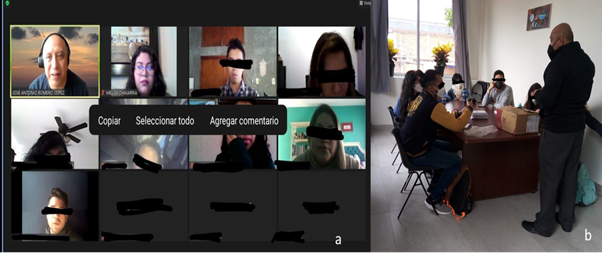
a) Distance learning through the Zoom platform. b) Classroom learning at
the FMVZ, UNAM
Creating a VLE
For both groups, an instructional design (ID) template written in Word format was used for specific planning, considering the basic requirements for the subject’s activities, according to Siemens (2002).
Platform and learning activities
The VLE was hosted on the Moodle platform, a Learning Management System (LMS) provided by CUAIEED, UNAM. The following resources were included as learning activities: videos; repositories (both in Moodle and Google Drive) with articles, books, digitized materials, and evaluation rubrics; a document on Problem-Based Analysis (PBA) with essential information for carrying out the work; Guevara (2010) a videoconference with experts in MP4 format, a discussion forum and wikis. See Figure 2.
Figure 2
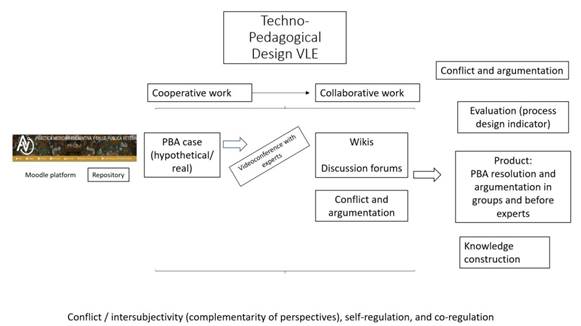
Resources used in learning activities
At the end of the course, the students presented their products in front of the group and before experts, to be evaluated academically, in addition to discussing the viability of their proposals and their suitability for work. The WhatsApp application and e-mail were used as means of communication.
Perception of the course. A seven-item questionnaire and instructions were prepared and administered to determine the perception of the course. Each question had to be answered on a scale of 0–10, with 10 being the best perception. In both groups, the tool was applied via Zoom.
Grading. At the beginning of the course, students were informed of the grading procedure. Students were given an average grade based on exams, assignments, and participation in discussions. The instructions and grading procedure were the same for both groups.
Analysis of results. Mean survey scores were compared between groups, question by question, as were mean scores. Significant differences were assessed using Student’s t-test if the data were normally distributed.
VLE development
Study groups. A total of 8 students attended the course in person, while 11 took the course virtually.
Grading. In terms of grades received in the course, the final average for distance learners was 9, while the average for face-to-face learners was 10. No significant differences were found between both groups (p > 0.05).
Perception. The results of each question in the questionnaire are shown in Table 1. It is noteworthy that in all the questions, except the last one, the students' perception was better in the face-to-face modality. The differences between both groups were significant (p < 0.05).
Table 1
Comparison of questionnaire results between the face-to-face group and the distance group
|
On-Site |
Distance |
|||||
|
No. |
Question |
Mean |
SD |
Mean |
SD |
p |
|
1 |
How would you rate this course? |
9.37 |
0.517 |
7.7 |
1.625 |
0.000 |
|
2 |
How would you rate the way the course was delivered to you? |
9.5 |
0.535 |
8.3 |
1.455 |
0.003 |
|
3 |
Did you find the content of the course useful for your future career? |
9.87 |
0.354 |
8.85 |
1.226 |
0.002 |
|
4 |
Do you feel that the format of the course allowed you to get more out of it? |
10 |
0.000 |
6.95 |
2.437 |
0.000 |
|
5 |
Depending on the format of the course, how easy was it for you? |
8 |
0.922 |
6.4 |
2.324 |
0.015 |
|
6 |
Do you feel that the format of the course allowed for full access to the information and delivery of the course? |
9.5 |
1.068 |
8.15 |
1.723 |
0.020 |
|
7 |
Did the course provide access to elements of communication and feedback from the instructor? |
10 |
0.000 |
9.7 |
0.728 |
0.080 |
In light of the experience during the COVID 19 pandemic, distance learning is an important resource that will undoubtedly continue to exist, as it has provided undeniable benefits, such as allowing students to continue their academic development from home through very accessible platforms such as Zoom or Google Meet. However, it is important to consider that it has also created problems, as social and physical contact is irreplaceable for anyone, and especially for students. According to Arenas et al. (2022), confinement triggered negative emotions and increased stress levels, which reduced cognitive and motivational performance. This could be the reason for the lower satisfaction of the students who took the course at a distance, while the students who took the course in person had better perceptions of the usefulness, interest, and difficulty of the course.
According to Ferrer, et al. (2020), students’ perceptions of distance learning may have been influenced by several aspects, including the fact that the pandemic forced the abrupt introduction of distance learning without teachers and students being prepared for it.
Another aspect that may be important is that after two years of confinement, the students in the distance group felt tired of this form of learning, while the students who returned to the classroom found the social contact offered by a face-to-face group rewarding. The physical distance between the community of students may have affected the ability to relate and changed the students’ experiences and expectations, leading to lack of motivation and dissatisfaction. Some authors mention that it is also important to consider the career the students are studying as well as the semester, as the career of a veterinarian is very hands-on, and this is particularly true in this course (Ferrer et al., 2020).
Face-to-face remains the best option in education, while distance learning is an excellent alternative, especially in the face of unforeseen events such as the recent pandemic, because it saves time and resources, especially when face-to-face involves traveling distances, especially in large urban areas. Unfortunately, distance or hybrid education must take into account the economic costs associated with the necessary equipment, connectivity costs, and, if necessary, repair costs. In this regard, Marques (2013) states that slightly more than 44% of households in Mexico still do not have access to the Internet. Meanwhile, the National Institute of Statistics and Geography (INEGI, 2020), in the National Survey on the Availability and Use of Information Technologies in Households, reports that there are 80.6 million Internet users in Mexico, representing 70.1% of the population aged 6 years and older. It also estimates the number of households that have access to this resource (56.4%), either through a fixed or mobile connection, at 20.1 million. The three main means for users to connect to the Internet were smartphones with 95.3%, laptops with 33.2% and desktop computers with 28.9%. It is noteworthy that the same survey indicated that more than 91% of users use the Internet for entertainment, more than 90% for information and just over 90% for communication (INEGI, 2020).
A VLE was implemented with the relevant technological and pedagogical resources for interaction between students and teachers, thus building knowledge in a collaborative way. In addition, a guide of basic and essential activities was created for teachers to develop it.
The results of the distance course were not statistically different from those of the face-to-face course. As for the students’ perception, it was better in the face-to-face modality, except for one question; however, this result may be influenced by the psychological effects of distance, especially at the end of the pandemic.
Although there is no substitute for face-to-face teaching, distance learning has great advantages and could be even more beneficial if teachers and students have the necessary prior knowledge to use it to its full potential. Likewise, it is advisable to implement a VLE with other topics of this and other subjects in order to have more information about the performance of these tools during the course.
Arenas, G., Robles, A., López, O., Olvera, J., y Ortega, L. (2022). Alteraciones emocionales y físicas en estudiantes universitarios ante el distanciamiento social por COVID 19. Alternativas en Psicología. 48, 98-109. https://www.researchgate.net/publication/359669425
Calandra, P., Araya, M., y Mocelli, M. (2009). Conociendo las TIC. Innova Chile. Facultad de Ciencias Agronómicas. Universidad de Chile. http://repositorio.uchile.cl/bitstream/handle/2250/120281/Calandra_Pedro_Conociendo_los_TIC.pdf;sequence=1#:~:text=Hace%205.000%20a%C3%B1os%2C%20egipcios%20y,la%20era%20de%20las%20TIC.
Cueva, M. A. (2025). Uso de las TIC en estudiantes de educación superior. Horizontes Revista de Investigación en Ciencias de la Educación, 9(36), 58-68. https://doi.org/10.33996/revistahorizontes.v9i36.900
Ferrer, J., Moncada, C., y Guerrero, A. (2020). El impacto del distanciamiento social en la percepción estudiantil de la modalidad educativa presencial respecto a la modalidad virtual. DOCERE. 23, 29–33. https://doi.org/10.33064/2020docere233108
Gargallo, A. (2018). La integración de las TIC en los procesos educativos y organizativos. Educar em Revista 34(69), 325-339. https://doi.org/10.1590/0104-4060.57305
Guevara, G. (2010). Aprendizaje basado en problemas como técnica didáctica para la enseñanza del tema de la recursividad. InterSedes: Revista de las Sedes Regionales 11(20), 142-167. https://revistas.ucr.ac.cr/index.php/intersedes/article/view/1019/1080
INEGI. (2020) Comunicado de prensa Num. 103/20 https://www.inegi.org.mx/contenidos/saladeprensa/boletines/2020/OtrTemEcon/ENDUTIH_2019.pdf
Juca, F. J. (2016). La educación a distancia, una necesidad para la formación de los profesionales. Universidad y Sociedad, 8 (1), 106-111. https://rus.ucf.edu.cu/index.php/rus/article/view/312
Ortiz Caraballo, C. D. (2017). Tres principios de la acción educativa de José Luis González-Simancas y Fernando Carbajo López (2010). Praxis & Saber, 8(17), 249-253. https://doi.org/10.19053/22160159.v8.n17.2018.7221
Siemens, G. (2002). Instructional design in elearning. https://eddl.tru.ca/wp-content/uploads/2018/12/instructional-design-in-e-learning-Siemens.pdf
UNAM. (2020). Coordinación de Universidad Abierta y Educación a Distancia. Propuesta de un Modelo Híbrido para la UNAM. https://cuaed.unam.mx/descargas/Modelo_Hibrido_UNAM.pdf
UNESCO. El derecho a la educación. [Internet]. UNESCO 2019. https://es.unesco.org/themes/derecho-a-educacion
Valarezo, J. W., y Santos, O. C. (2019). Las Tecnologías del Aprendizaje y el Conocimiento en la formación docente. Conrado, 15(68), 180-186. https://hdl.handle.net/20.500.14330/CLA01000486832
Zubieta, J., & Claudio, R. (2016). La Educación a Distancia en México. Researchgate https://doi.org/DOI:10.13140/RG.2.1.1440.9360